Köpük Taşması Uyarısı! Su Arıtma Köpük Önleyici Kullanımında Önemli Noktalar
Normally, while a cooling tower is running, small quantity foams that disappear very quickly occasionally appear and are mainly caused by water movement and air bubbles. Nevertheless, if foam amount suddenly goes up, the foam lasts for long without going away or it happens alongside water change to green, bad smell or slime build-up it is clear that this is no regular issue. Usually, a lot of foaming is a pointer to something going wrong in areas like microorganisms population, organic matter, chemicals concentration or other water operation conditions which necessitate investigation and correction measures as soon as possible.
The reasons why the foaming phenomena occur in the cooling water of industrial cooling systems can mainly be attributed to three causes.Initially, the presence of surface-active compounds in water is the first reason. Among these substances, there are, for example, residues from the decomposition of additives like corrosion and scale inhibitors, leaked materials from the process, and also extracellular polymeric substances from microbial metabolism.Secondary, the large quantities of air injected into the water during the aeration and spraying operation processes are a reason. Indeed, the fragmentation of water droplets in the cooling tower fill bed is, itself, an air entrainment.The last factor is an increase in the temperature of the water, which decreases the surface tension of the water thus making the foam more stable. This results in less easy removal by a natural means from the foam.
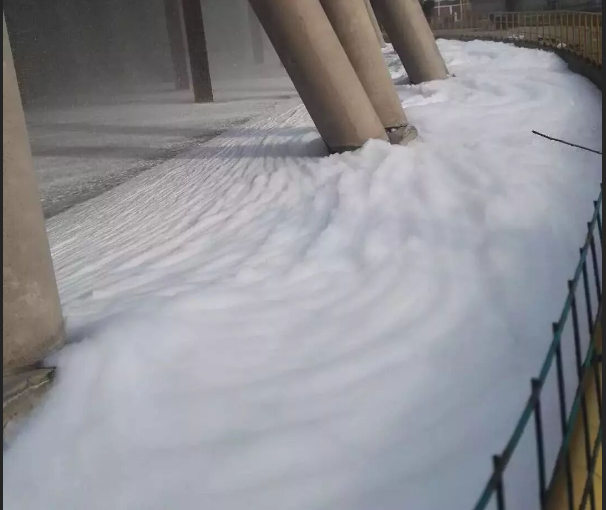
Selecting an antifoam for circulating cooling water systems involves specific considerations. These systems typically operate under mildly alkaline conditions (pH 7.5–9.0) with water temperatures ranging from 30°C to 45°C; consequently, the antifoam must exhibit good thermal and chemical stability without interfering with the performance of corrosion and scale inhibitors. Silicone-based antifoams are widely used in these systems due to their rapid defoaming action and low dosage requirements; however, in systems sensitive to silica scaling, polyether or modified polyether antifoams may be a safer choice.
Defoaming mechanisms of antifoam
Reduction of local surface tension causes foam collapse.
Promotion of liquid film drainage leads to bubble rupture.
Solubilization of foam-stabilizing surfactants can cause bubble rupture.
Disruption of film elasticity leads to bubble rupture.
Common types of defoamers
Silicone-based defoamers
Polyether-based defoamers
Mineral oil-based defoamers
Dosage of antifoam
Alcohol-based antifoam: The dosage is generally within the range of 0.01–0.10%.
Oil/fat-based antifoam: The dosage for oil/fat-based defoamers is between 0.05% and 2%, while for fatty acid ester antifoam, it is between 0.002% and 0.2%.
Amid bazlı köpük önleyiciler: Bunlar oldukça etkilidir ve tipik dozajları %0,002–0,005 aralığındadır.
Fosfat bazlıköpük önleyiciEn yaygın olarak elyaf ve yağlama yağlarında, %0,025 ile %0,25 arasında bir dozda kullanılır.
Amin bazlı köpük önleyici: Esas olarak elyaf işlemede %0,02–2 oranında kullanılır.
Eter bazlı köpük önleyici: Kağıt üretimi, baskı, boyama ve temizleme işlemlerinde yaygın olarak kullanılır; dozajı genellikle %0,025–0,25'tir.
Köpük önleyici ürünlerle ilgili her türlü soru veya endişeniz için lütfen bizimle iletişime geçmekten çekinmeyin; 20 yıllık Ar-Ge deneyimimizle üretiminizin verimliliğini artırmanıza yardımcı oluyoruz.Ücretsiz numuneler için bizimle iletişime geçin!